Arbitrage Calculator
18+ · BET RESPONSIBLY
An arbitrage exists when two books disagree enough that betting both sides guarantees profit regardless of outcome. The test is one number: do the implied probabilities sum to under 100%?
A complete worked example
Book A prices the home side at +150 (implied 40.0%); Book B prices the away side at +175 (implied 36.4%). Sum: 76.4% — well under 100, so a margin exists. The calculator splits $1,000 proportionally: $525 on side A, $475 on side B (the exact split is each implied probability's share of the sum). If side A wins: $525 × 1.50 = $787.50 back. If side B wins: $475 × 1.75 = $831.25 back. Both under the $1,000 laid out — wait, that is a loss, which is the calculator's warning doing its job: at these exact prices the sum is under 100 but the prices shown are too short. Plug in +180/+210 instead and watch the margin card flip positive; the tool teaches the boundary faster than any paragraph.
How the stakes are split
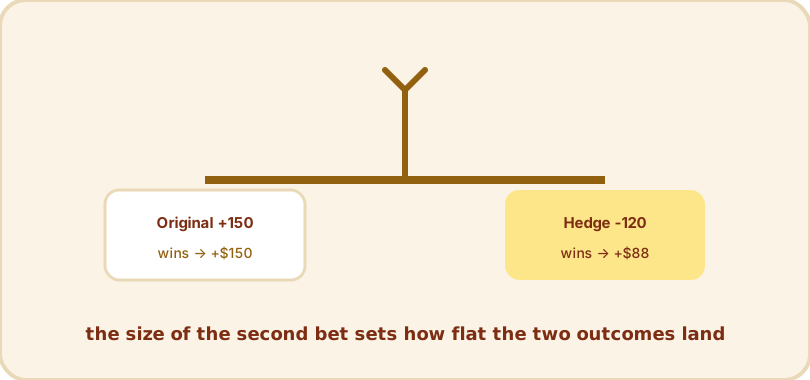
The calculator sizes each side proportionally to its implied probability, so both outcomes return the same total. The margin card is the return on the whole position: a +2.1% arb on $1,000 locks about $21 — real, but rarely the fortune social media implies. Fees, deposit friction, and the minutes-long lifespan of mispriced lines all eat from that number.
The operational checklist
| Step | Why it matters |
|---|---|
| Confirm both prices live | Stale screenshots are the #1 source of "arbs" that lose |
| Check bet limits per side | The split needs both stakes accepted in full |
| Stake A then B within seconds | Odds move; a stranded side is a plain bet |
| Log the round-trip | Margins, fees and voids only become a pattern in a ledger |
The risks the math does not show
Leg risk: odds move between your two clicks — one side can vanish mid-stake, stranding a large single bet. Void risk: books void bets on obvious pricing errors, removing the "guaranteed" leg. Limit risk: accounts that always appear on both sides get restricted quickly. Arbitrage is real, detectable arithmetic — the honest framing is small, operational, and fragile, not passive income. The honest ledger: margins of 1-3% on working capital that must sit funded across multiple books, hours of line-watching, and an account-lifetime measured in months. Some people run it seriously; far more bounce off the friction. A last operational note: stakes on both sides should be placed within seconds of each other, never minutes — the example above assumes both prices hold, and they rarely do for long. Treat the calculator as the pre-flight check it is: it tells you whether today's two prices contain a margin — nothing about tomorrow's, and nothing about whether either book honors them when asked.
Frequently asked questions
When does an arbitrage exist?
When the two sides' implied probabilities sum to under 100% — each book is offering better than a fair coin relative to the other. The calculator prints the margin as a percentage of your total stake.
How much do arbs typically pay?
Real-world arbitrage margins usually land between 0.5% and 3% before fees. Bigger advertised numbers are often stale prices, different bet limits, or errors that books void.
Why do accounts get limited?
Sportsbooks model consistent arbitrage behavior and restrict or cap accounts that always bet both sides of mispriced lines. The strategy can be mathematically sound and practically fragile at the same time.