Odds Conversion Table
18+ · BET RESPONSIBLY
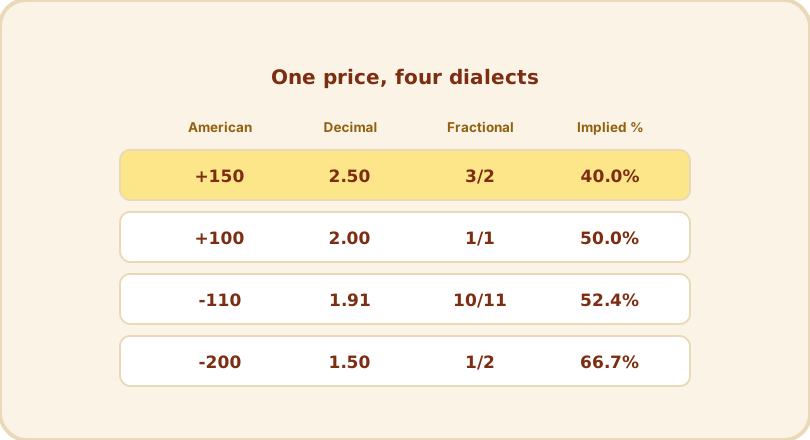
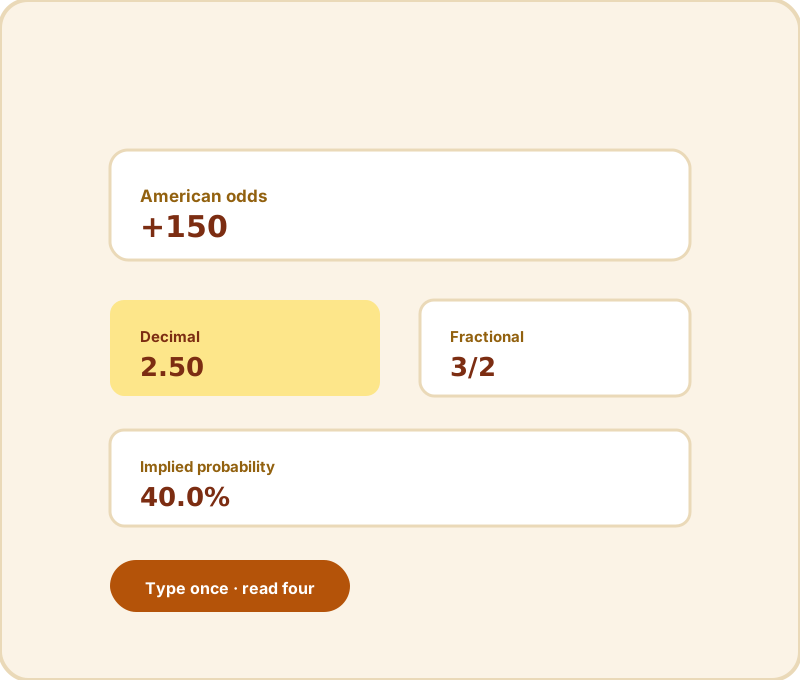
Every common price from -400 to +400: American odds, the decimal equivalent, the implied probability, and what a $100 bet returns. Bookmark it for board-reading.
| American | Decimal | Implied % | $100 bet returns |
|---|---|---|---|
| Loading… | |||
The three conversions, by hand
American → decimal: underdogs divide by 100 and add one (+150 → 2.50); favorites divide 100 by the price and add one (−200 → 1.50). Decimal → implied probability: one divided by the decimal (2.50 → 40%). American → implied directly: for underdogs, 100 ÷ (price + 100); for favorites, |price| ÷ (|price| + 100). Three lines of arithmetic cover every cell in the table — the whole board is one idea wearing different notation.
Fractional odds, briefly
British bookmaking's native format (3/2, 10/11) reads as profit-to-stake: 3/2 wins $3 per $2 staked — decimal 2.50, identical to +150. Fractional prices look exotic to American eyes and map cleanly: x/y is decimal (1 + x/y). You meet them at UK-facing books and in horse racing, where they remain the vernacular.
Where the table's edges get interesting
The extremes tell stories. At −400, you risk four dollars to win one: the market is 80% sure, and prices that confident are where favorites get upset in ways that cost books money. At +400, the implied 20% is the market saying this happens a fifth of the time — twice as often as a round-number "long shot" intuition suggests. Bettors who internalize the implied column stop being surprised by underdog wins; the board said one in five all along.
How to read the table like a bookmaker
Scan the implied column and watch the pattern: the table's heart is where prices cluster — most markets live between -110 and +150, and the implied probabilities there are engineered around a fair line plus margin. Prices far from the heart (±400) are either genuinely lopsided matchups or markets with few participants, which is why their margins run wider. When comparing books, a half-point of decimal odds on the same side is real money over a season of bets — line shopping is the cheapest edge available. Print this page or keep it open in a second tab while you read a board — after a week of looking prices up, you will stop needing it, which is the intended outcome. Nothing here requires an account, and nothing is uploaded — the math runs entirely in your browser, and the pages you are reading cost the same to serve whether you are a first-time visitor or a professional — which is why every page here can stay free for good, no asterisks attached.
Common mental slips the table prevents
Reading −150 as "win $150" (it is: stake $150 to win $100); assuming +400 means the outcome is impossible (implied: 20%); and comparing a decimal price from one book against an American price from another without converting — the table exists so none of these survive a second glance.
Frequently asked questions
How do I convert American odds mentally?
Underdogs (+): divide the odds by 100 and add 1 for decimal (+150 → 2.50). Favorites (−): divide 100 by the odds and add 1 (−200 → 1.50).
What does -110 mean in probability?
About 52.4% implied — the standard even-match price with the bookmaker margin included. The fair 50% coin is priced at -110/-110.
Why do some sites show different decimals for the same American odds?
Rounding. -110 is exactly 1.9090…, shown as 1.91. Three decimal places removes almost all ambiguity when comparing prices across books.